
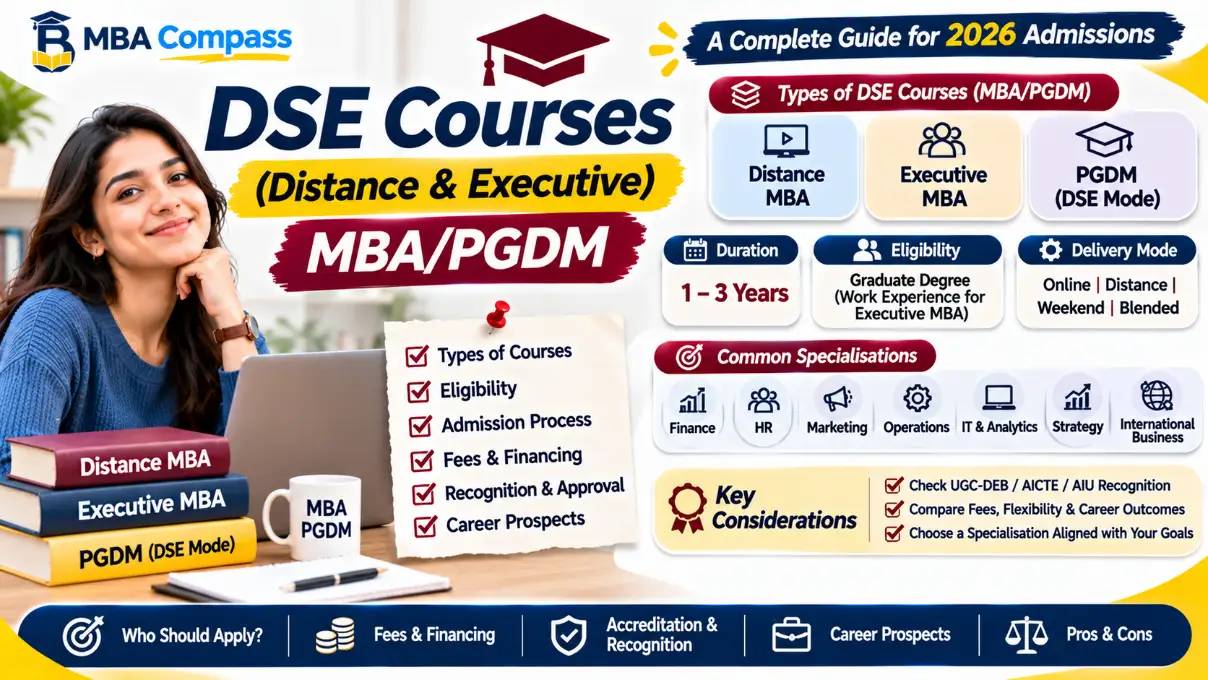
What DSE means for MBA/PGDM applicants
DSE in this article refers specifically to two delivery modes used for management education: Distance MBA/PGDM programmes and Executive MBA/PGDM programmes delivered under distance, blended or modular formats. Distance programmes are designed for learners who cannot attend regular campus classes and rely primarily on remote learning; executive programmes target experienced professionals and use a mix of weekend, modular and online delivery to accommodate work commitments.
Distance MBA/PGDM programmes typically emphasise flexible pacing, recorded lectures, study material and periodic contact sessions. Executive MBA/PGDM pathways prioritise cohort-based peer learning, weekend residencies, and applied projects that participants' work experience. Both modes often include assessments through assignments, proctored online exams or in-person term-end tests depending on the provider.
This article excludes other meanings of DSE such as Directorate of School Education or unrelated acronyms. It also does not cover standard full-time two-year residential MBA/PGDM programmes unless they offer a distinct distance or executive delivery stream. Where regulatory recognition matters, this guide discusses UGC-DEB and AICTE/AIU implications for distance and PGDM awards in the sections that follow.
Also Read: MBA Compass
UPDATE: UGC's distance education regulations and DEB approvals are the most time-sensitive facts affecting DSE programmes; check the regulator's listings for specific programme recognition before applying.
Who should consider DSE courses
DSE courses suit working professionals and graduates who need programme flexibility while earning a management credential. Mid-career candidates, employees with location or shift constraints, and those seeking functional specialisation without a two-year campus break commonly choose distance or executive modes.
Profiles that typically fit DSE routes include:
- Mid-career professionals (5+ years) aiming for role upgrade or domain shift while continuing employment.
- Early-career graduates who cannot relocate for full-time study and prefer part-time or blended learning.
- Employees in geographically remote locations or with rotational/shift schedules needing asynchronous content and weekend contact sessions.
- Entrepreneurs and family-business successors requiring targeted modules (finance, strategy, operations) with minimal campus time.
Payoffs for suitable candidates are practical: applying current work experience to case-based learning, immediate workplace impact, and maintaining income while studying. For many, an executive or distance MBA/PGDM accelerates promotions and prepares for leadership roles without the opportunity cost of a full-time programme.
Limitations to weigh are credibility and recognition nuances: distance MBAs require scrutiny for UGC-DEB approval and AIU equivalence; PGDMs delivered in executive formats must clarify AICTE and institutional accreditation status before enrolment.
Also consider programme fit with desired specialisation and employer perception. Candidates targeting large-campus recruitment or high-growth consulting and investment roles should compare outcomes against full-time options before deciding.
Types of DSE courses related to MBA/PGDM
DSE courses related to MBA/PGDM include three principal types: Distance MBA, Executive MBA (offered in DSE modes such as weekend or modular delivery), and PGDM via DSE (postgraduate diplomas delivered through distance/blended formats). Each type targets different learner profiles and uses varied delivery schedules.
| Type | Typical duration | Delivery mode | Typical eligibility |
|---|---|---|---|
| Distance MBA | 2–3 years | Fully distance or online with occasional contact sessions | Graduate degree (UG) |
| Executive MBA | 1–2 years | Weekend, modular or blended (online + contact) | Graduate degree + work experience (commonly 3–5 years) |
| PGDM (DSE mode) | 1–2 years | Blended or distance; may include contact modules | Graduate degree; some programmes prefer work experience |
The table summarises commonly offered DSE course types for management study. Distance MBAs follow a longer, asynchronous structure suited for learners who need flexibility; executive MBAs compress management curricula into shorter, cohort-based formats that require prior work experience; PGDMs delivered via DSE modes mirror industry-oriented diploma content and may use blended teaching to meet AICTE-style quality expectations when applicable.
Also Read: MBA Compass
Common MBA/PGDM specialisations via DSE programmes
DSE courses for MBA/PGDM commonly cover the standard management specialisations; the list below identifies popular choices and representative elective subjects students typically encounter. The attached table summarises each specialisation with sample electives and typical roles.
| Specialisation | Sample electives/subjects | Typical career roles |
|---|---|---|
| Finance | Corporate Finance; Financial Markets; Investment Analysis; Risk Management; Banking Operations | Financial Analyst; Credit Manager; Investment Associate; Treasury Executive |
| Marketing | Consumer Behaviour; Brand Management; Digital Marketing; Market Research; Sales Management | Brand Manager; Marketing Executive; Market Research Analyst; Sales Manager |
| Human Resources (HR) | Talent Acquisition; Compensation & Benefits; Labour Laws; Organisational Development; Training & Development | HR Manager; Recruitment Specialist; L&D Manager; HR Business Partner |
| Operations & Supply Chain | Operations Management; Logistics; Inventory Management; Quality Management; Supplier Relationship Management | Operations Manager; Supply Chain Analyst; Logistics Coordinator; Procurement Executive |
| Information Technology / Systems | IT Management; Business Analytics; ERP Systems; Database Management; Project Management | IT Manager; Systems Analyst; Business Analyst; Project Manager |
| International Business | International Trade; Cross-cultural Management; Export-import Management; Global Supply Chains | International Trade Executive; Export Manager; Global Business Analyst; International Sales Manager |
| Healthcare / Hospital Management | Healthcare Systems; Hospital Operations; Health Policy; Healthcare Finance | Hospital Administrator; Healthcare Manager; Operations Lead (Hospitals) |
| Business Analytics | Data Mining; Predictive Analytics; Statistical Modelling; Visualisation; Machine Learning basics | Business Analyst; Data Analyst; Analytics Consultant; BI Specialist |
Most DSE programmes allow students to choose electives within these broad streams; elective availability depends on the provider's syllabus and faculty strength. For working professionals, specialisations such as Finance, HR, Marketing and Business Analytics are the most commonly offered in blended or executive formats.
Duration and format details for 2026 admissions
DSE courses for MBA/PGDM applicants are offered in several pacing and residency formats. Typical durations depend on programme type: distance and executive MBAs commonly span 1–3 years, while traditional full-time PGDMs usually run for 2 years. Delivery can be fully online, blended (online plus contact sessions), weekend/modular or intensive residency formats.
Below is a concise table showing common course types, their typical durations and pacing options.
| Course type | Typical duration | Pacing options | Contact/residency frequency |
|---|---|---|---|
| Distance MBA | 1–3 years | Self-paced; term-based trimesters or semesters | Occasional contact sessions or regional study centres; frequency varies by provider |
| Executive MBA (DSE mode) | 1–3 years | Modular/weekend intensives; cohort-paced | Weekend classes or intensive residencies (monthly/quarterly) depending on programme |
| PGDM (executive/distance variants) | 1–3 years | Blended formats with structured term schedules | Periodic on-campus workshops and final residency requirements |
| Full-time PGDM | 2 years | Fixed-semester pacing with daily classes | On-campus, regular weekday residency throughout programme |
Interpretation: DSE-mode distance and executive MBAs offer flexible pacing for working professionals; many providers allow completion in as little as one year for experienced candidates or extend to three years for part-time learners. Full-time PGDMs retain a standard 2-year academic timeline with continuous campus residency and a fixed semester structure.
Also Read: College Shortlister
update: For 2026 admissions, specific residency frequency and allowed programme duration must be confirmed on each provider's official programme page before application.
Eligibility criteria by course type
Eligibility for DSE courses varies by delivery mode; the principal differences are the minimum academic qualification and the need for work experience for executive routes. The table below summarises standard entry requirements reported across DSE-format MBA/PGDM offerings in India.
| Course type | Minimum education | Work experience required | Other criteria |
|---|---|---|---|
| Distance MBA (DSE-distance) | Graduation (any discipline) | Typically none | Recognition by UGC-DEB and AIU equivalence recommended |
| Executive MBA (DSE-executive) | Graduation (any discipline) | 1–5 years (common requirement) | Age: institutions may set minimum working-age expectations; selection often includes interview |
| PGDM via DSE-mode | Graduation (any discipline) | Varies; many require experience for executive-format PGDMs | AICTE/AIU recognition and institute-level validation important |
Interpretation: graduation is the baseline academic requirement across DSE courses. Executive MBA routes commonly expect at least some professional experience; selection panels favour candidates with demonstrable managerial responsibilities. Distance MBAs often admit fresh graduates but verifying UGC-DEB listing or AIU equivalence is critical for degree recognition.
Admission process and common tests for DSE courses
DSE courses for MBA/PGDM admission use a mix of entrance tests, merit-based selection, direct admission and employer sponsorship depending on the course type. Executive and distance MBA/PGDM routes commonly accept work-experience and academic qualifications in place of high‑stakes entrance tests; some institutions also shortlist candidates through institution-level tests.
Below table summarises common entry routes by course type and typical selection stages.
| Course type | Common entrance tests/criteria | Interview/selection rounds |
|---|---|---|
| Distance MBA | Institutional merit / qualifying degree; some accept national tests (CMAT/MAT) | Document verification; occasional recorded video interview or contact-centre counselling |
| Executive MBA | Prior degree + minimum work experience; some accept CAT/GMAT/CMAT or institute tests | Shortlisting on CV, personal interview (in-person/online), managerial assessment |
| PGDM via DSE (blended/executive PGDM) | Institute-level entrance or national tests where applicable; work experience considered | Group discussion, personal interview, past academic/work record |
Institutions that offer DSE-mode programmes vary their emphasis: distance MBA admissions often rely on academic merit and document checks, while executive MBAs place heavier weight on verified work experience and interviews. Employer sponsorship is a recognised route for executive programmes and typically requires an employer letter confirming sponsorship and release for any mandatory contact modules.
Prospective applicants should check the specific programme brochure for exact test acceptance and shortlisting rules before applying. For blended or PGDM programmes where AICTE/other accreditation matters, confirmed acceptance of national tests or institute-level selection must be verified in the programme information.
Accreditation, recognition and verification checklist
DSE courses used in this article refer to distance and executive MBA/PGDM pathways. Accreditation and formal recognition determine whether a diploma or degree is accepted by employers, further education providers and credential evaluators. UGC-DEB approval covers distance degree programmes; AICTE regulates PGDMs; AIU equivalence can affect degree recognition for higher studies.
Follow this concise checklist to verify authenticity before applying:
- Confirm UGC-DEB approval for any distance MBA or degree programme. The University Grants Commission–Distance Education Bureau (UGC-DEB) is the statutory authority that must approve distance degree-level programmes delivered by universities.
- Check AICTE oversight for PGDM programmes. PGDMs are typically run by autonomous institutes and should meet AICTE norms where applicable; absence of AICTE recognition for a PGDM may affect acceptability in some contexts.
- Ask about AIU equivalence if you plan higher studies abroad or within India. An AIU equivalence certificate for a distance MBA degree eases transfer and recognition with universities that require a regular degree equivalence.
- Confirm the awarding body and its statutory status (central/state university, deemed university, or autonomous institute). Verify the institution’s legal name on its official website and in regulatory lists.
- Review credentials and accreditations such as NAAC, NBA or international accrediting bodies if provided. These add quality signals but are secondary to statutory recognitions above.
- Request a sample provisional certificate and check for the issuing authority’s seal, serial numbers and signature formats used by the university.
For distance MBAs, UGC-DEB approval is the fundamental requirement for degree validity in India. For PGDMs, confirm AICTE applicability; if the institute claims equivalence, ask for documentary proof.
Verification steps: cross-check the programme name against the UGC-DEB and AICTE published lists on their official sites; confirm any AIU equivalence letters directly with AIU; compare fee and course details on the institution’s official site.
Red flags: no regulatory listing, promises of guaranteed placement or foreign accreditation without verifiable documentation, inconsistent programme names between prospectus and certificate, and requests to pay full fees to personal accounts.
Also Read: MBA Compass
Fees, financing and fee bands for DSE programmes
DSE-mode MBA/PGDM fees are generally lower than the highest full-time MBA/PGDM totals but vary widely by provider type; this section compares qualitative bands and offers financing options.
| Programme type | Typical fee band (INR) | Financing options |
|---|---|---|
| Distance MBA / DSE distance programmes | INR 0.6 lakh to INR 1.4 lakh (institution examples in database: Vidyasagar University 0.6 lakh; ICFAI University Mizoram 1.4 lakh) | Education loans from banks, EMI by provider where available, employer sponsorship for working professionals |
| Executive MBA (modular/weekend) | INR 1.2 lakh to INR 7 lakh (comparative reference: lower end similar to smaller local B-schools; full-time university totals in database such as Vel Tech University 7 lakh) | Bank loans (shorter tenors), employer funding, deferred payment plans |
| Full-time PGDM / MBA (for comparison) | INR 1.3 lakh to INR 19 lakh (database examples: GJUS&T Hisar 1.3 lakh; XIME Bangalore 19 lakh) | Standard education loans, scholarships, instalment plans |
Practical interpretation: the verified database shows several public and private universities with very low total fees (e.g., Vidyasagar University INR 0.6 lakh) at one end and private management schools charging multi-lakh totals at the other. Distance and executive DSE offerings usually sit towards the lower-to-mid of this range because they do not carry full residential costs.
Financing routes: salaried applicants commonly use bank education loans, employer sponsorship or provider EMIs; older executives often negotiate deferred payment or sponsorship. Check whether the programme is eligible for bank loan schemes and whether the provider holds necessary recognition (see accreditation checklist).
Mode of delivery, assessments and learning support
DSE courses use a mix of online, blended and weekend/modular formats to suit working professionals and remote learners. Delivery commonly combines recorded lectures, live webinars, optional on-campus contact sessions and downloadable study materials; most programmes emphasise flexibility so students can continue employment while studying.
Assessments in DSE-mode MBA/PGDM programmes typically include timed online quizzes, end-term proctored exams, project submissions and workplace-based assessments such as company-sponsored projects or capstone assignments. Continuous assessment through assignments and participation in discussion forums is standard in blended delivery.
Contact or residency sessions vary by provider: some programmes schedule concentrated weekend classes or 3–7 day modules each semester for in-person teaching, live case discussions and assessments. Others maintain purely online residencies delivered as synchronous workshops. Practical elements such as internships or industry projects may be organised as short-term placements or guided company projects compatible with employment.
Learning support for DSE students commonly includes online learning management systems (LMS) with recorded content and reading lists, live doubt-clearing sessions, dedicated faculty mentors or academic counsellors, and peer discussion forums. Career services for executive and distance students often focus on resume reviews, virtual networking events and placement assistance tailored to part-time learners.
Quality assurance measures to look for include scheduled proctored examinations (online or on-campus), clear assessment weightage for projects versus exams, and access to faculty or counsellors for assessment grievances. Verify whether the programme requires campus attendance for final exams or residencies before enrolling.
Also Read: College Shortlister
Career prospects by specialisation and pros/cons of DSE routes
DSE courses can lead to the same functional roles as full-time MBAs for many specialisations, with career progression shaped by prior work experience and industry acceptance. The table below summarises common specialisations, typical roles and broad qualitative salary bands.
| Specialisation | Typical roles | Salary band (broad) |
|---|---|---|
| Finance | Financial analyst, corporate finance associate, treasury, credit analyst | Mid-level: ₹4–10 LPA; senior: ₹8–20+ LPA |
| Marketing | Brand executive, product manager (entry via experience), sales manager, digital marketing specialist | Mid-level: ₹3.5–8 LPA; senior: ₹8–18 LPA |
| Human Resources | HR generalist, talent acquisition specialist, L&D coordinator, HR business partner | Mid-level: ₹3–7 LPA; senior: ₹8–15 LPA |
| Operations & Supply Chain | Operations manager, logistics planner, procurement executive, supply chain analyst | Mid-level: ₹3.5–8.5 LPA; senior: ₹8–18 LPA |
| Business Analytics | Data analyst, business analyst, analytics consultant, BI developer | Mid-level: ₹4–10 LPA; senior: ₹10–20+ LPA |
| International Business / IB | Export manager, international marketing, trade analyst, global sourcing | Mid-level: ₹4–9 LPA; senior: ₹9–18 LPA |
Salary bands above are broad qualitative bands reflecting typical private-sector ranges for MBA-level functional roles in India; prospective students should cross-check with employer and alumni data for specific programmes.
Pros of DSE routes: flexible schedules for working professionals, lower opportunity cost compared with full-time study, modular and weekend formats that allow immediate application of learning, and often lower fees than premium full-time programmes. Cons: variable employer recognition for distance formats, limited on-campus recruitment at some providers, fewer full-time campus networking opportunities, and quality variation across providers (verify UGC-DEB/AIU/AICTE status where relevant).
Practical pointers: match specialisation to existing experience to maximise salary uplift; prefer accredited DSE providers and programmes with strong alumni engagement; plan for blended or weekend contact sessions to build peer networks.
Important Points
- Recognition Check UGC-DEB approval and AIU equivalence for distance MBAs; AICTE is relevant for PGDMs.
- Course types DSE routes include Distance MBA, Executive MBA and PGDM offered in blended or modular formats; durations vary from 1 to 3 years depending on format.
- Experience rule Executive MBA programmes typically require 2–5 years of work experience; distance MBAs accept fresh graduates in many cases.
- Fee bands Distance/Executive MBA fees commonly fall below full-time PGDM fees; institutes in the verified set show total fees ranging from INR 0.6 lakh to INR 19 lakh across formats (see specific programmes for exact figures).
- Delivery Blended modes include online lectures, weekend contact sessions and term-end exams; check study-centre and contact-hour commitments before applying.
Take the next step: Start your MBA journey today by exploring colleges that fit your profile and comparing fee-to-ROI outcomes. Use the College Shortlister, run a fit analysis in the Profile Analyzer, and model finances with the MBA ROI Calculator.
Similar Colleges to Check
Compare these colleges alongside DSE Courses & Programs before you finalise your shortlist.
| College | What to compare |
|---|---|
| Gayatri Vidya Parishad College for Degree and PG Courses | Fees, cut-offs and placements |
| Gayatri Vidya Parishad College for Degree and PG Courses Management | Fees, cut-offs and placements |
| IIT Bhilai (MBA) | Fees, cut-offs and placements |
| IIT Dharwad (MBA) | Fees, cut-offs and placements |
| IIT Gandhinagar (MBA) | Fees, cut-offs and placements |
| IIT Gandhinagar (MBA) | Fees, cut-offs and placements |
| IIT Indore (MBA) | Fees, cut-offs and placements |
| IIT Indore (MBA) | Fees, cut-offs and placements |
Related Reads
Frequently Asked Questions
What is the difference between DSE courses and a regular full-time MBA?
DSE courses are delivered via distance, executive or blended formats allowing part-time study and flexible schedules; full-time MBAs are campus-based two-year programmes with daily classes, internships and campus placement drives.
Are distance or executive MBAs recognised for government jobs and higher studies?
Recognition depends on approval: distance MBAs must have UGC-DEB approval and AIU equivalence to be acceptable for government jobs and postgraduate study; PGDMs should have AICTE recognition and institute accreditation where applicable.
How much work experience is required for executive MBA admissions?
Executive MBA programmes commonly require 2–5 years of professional experience; some senior executive formats require more. Distance MBAs usually admit fresh graduates as well.
What accreditations should I check for a distance MBA or PGDM?
Check for UGC-DEB approval and AIU equivalence for distance MBAs, and AICTE recognition for PGDMs; additional quality signals include NAAC, NBA or international accreditations.
Can I get an education loan for a DSE course?
Education loans are often available for accredited DSE courses; lenders typically require recognised programme approval (UGC-DEB/AICTE) and may ask for collateral or co-borrower depending on loan amount.
How do employers view distance or executive MBA qualifications?
Employers value executive MBAs for work experience and applied learning; distance MBAs are considered when the provider is recognised and the candidate demonstrates applicable skills and experience.
Conclusion
DSE courses provide flexible study routes into management through distance, executive and blended PGDM/MBA formats that suit working professionals and those needing schedule flexibility. Carefully verify recognition (UGC-DEB/AIU for distance, AICTE for PGDM), match specialisations to your career stage, and compare fee-to-ROI outcomes before committing. A regulated, accredited DSE course can deliver comparable skills and career outcomes to traditional MBAs when aligned with work experience and employer expectations.
About MBA Compass
MBA Compass is an MBA discovery and decision platform created by B School Buzz to help Indian students and working professionals make informed postgraduate choices. The platform offers practical tools to shortlist colleges, analyse individual profiles and compare programmes, as well as resources such as full mocks and application preparation guidance. Its focus includes financial decision-making: it helps users model fees, expected packages and long-term return on investment to assess the economic sense of an MBA or PGDM.
MBA Compass is educational rather than promotional: its content supports evidence-based comparisons and career-fit analysis to guide real application choices. Use the tools to refine your list and plan finances: MBA Compass, College Shortlister, Profile Analyzer, MBA ROI Calculator.