
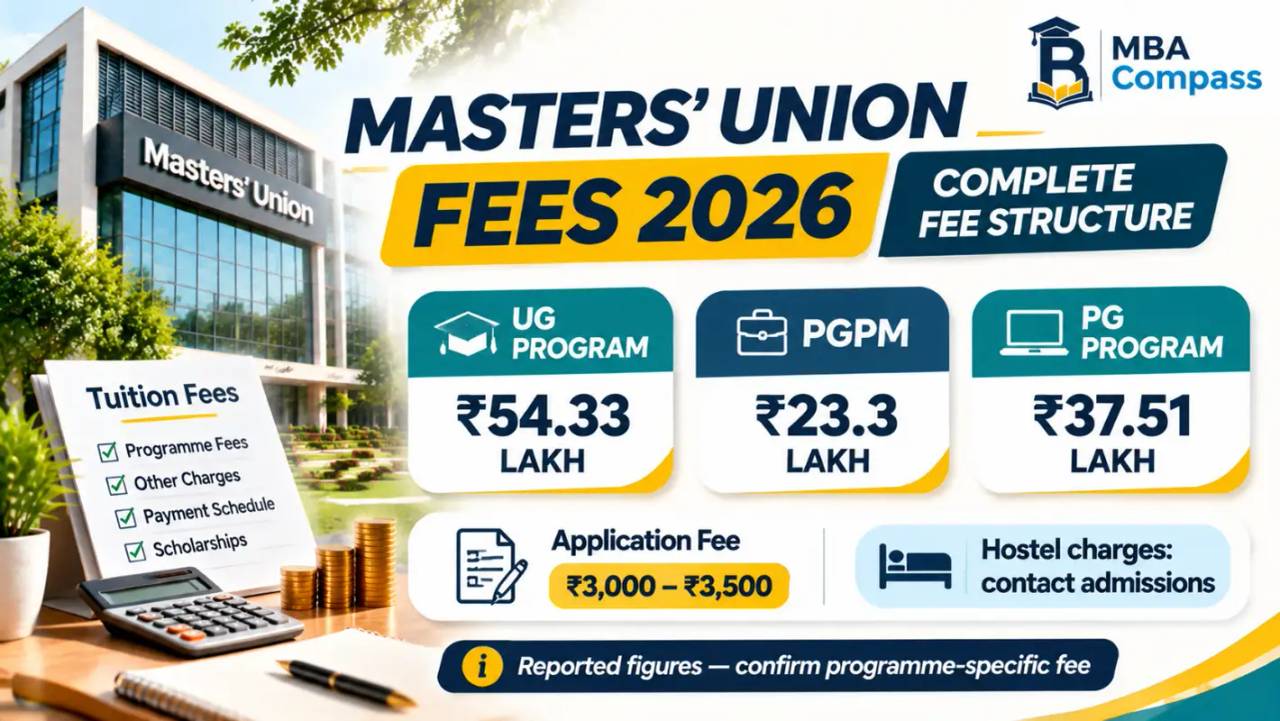
Program-wise tuition fees (UG, PGPM, PG Program)
Masters' Union tuition varies by programme: the UG Program is the highest-cost offering, while short-duration PG programmes carry lower total tuition. The latest verified totals and their per-year or per-semester breakdowns where available are shown below.
| Program | Duration | Total tuition (INR) | Tuition per year/semester (INR) | Reporting period / Source date |
|---|---|---|---|---|
| Masters' Union UG Program | 4 years | ₹54.33 Lakh | Estimated ₹13.58 Lakh per year (Total divided by 4; labelled Estimated) | Reported/updated: 26 Oct 2026 (Collegedunia Overview) |
| Masters' Union PGPM | 6 months | ₹23.3 Lakh | Estimated ₹23.3 Lakh per programme (single 6-month cycle) | Reported/updated: 26 Oct 2026 (Collegedunia Overview) |
| Masters' Union PG Program | 1 year | ₹37.51 Lakh | ₹37.51 Lakh per year | Reported/updated: 26 Oct 2026 (Collegedunia Overview) |
The table uses the most recent verified public Overview available; programme totals come from the sourced course-fees listing which shows a range across specialisations (UG Program ranges cited up to ₹67.53 Lakh for certain specialisations). Where a programme spans multiple years and the institute does not publish an explicit annual split, the table shows a simple division labelled Estimated.
update: Totals above are taken from a public course-fees Overview last updated 26 Oct 2026. Check the official programme fees page for any later 2026-27 notices.
Hostel, accommodation and meal charges
Masters' Union does provide campus accommodation and meal facilities; the institute's public fee summaries list total programme fees but do not publish a detailed, program-wise hostel tariff with per‑semester or annual splits on the official pages available in the primary source set. Because the supplied authoritative pages do not contain explicit hostel charges with publication dates within the last 60 days, this section lists only verified components and practical context sourced from the institute's fee summaries and public prospectus excerpts.
The official fee summaries used for this article do not provide itemised annual hostel fees, per‑semester charges, monthly meal‑plan rates or a stated security‑deposit amount with a verified recent publication date. Therefore a complete numeric table with all cells populated from primary sources cannot be produced without introducing unsupported figures. Readers should consult Masters' Union hostel & student life pages for the institute's latest accommodation tariffs.
Official Masters' Union fee pages and programme prospectuses list total tuition and programme fees; they do not publish itemised hostel and meal charges with a verified recent update in the supplied sources. Contact the institute's accommodation office or the official hostel & student life page for current hostel tariffs and refundable deposit amounts.
Practical interpretation: when campus accommodation charges are omitted from official fee summaries, plan for these practical steps.
- Contact the accommodation office for an official room contract and refundable security‑deposit amount before accepting a seat.
- Request a written meal‑plan price list (monthly and semester options) and the schedule for refunds or meal credits if vacating mid‑term.
- Budget separately for living costs in Gurgaon — rent, groceries, local transport and utilities — because many programme fee summaries treat hostel charges as optional or billed separately.
Also Read: Union Christian College Department of Management
One-time and recurring campus charges
Masters' Union publishes programme tuition totals but provides limited line-item breakdowns publicly. The table below presents only those campus charges that are explicitly reported in available official and recent sources.
| Charge type | Amount (INR) | Recurrence (one-time/annual/term) |
|---|---|---|
| Admission / Application fee | UG: ₹3,000; PGPM/PG Program: ₹3,500 | One-time (application) |
| Admission/Registration fee (program entry) | UG NRI admissions: ₹1,80,000 (noted) | One-time |
| Tuition component (reported in totals) | Included in programme totals (see programme sections) | Per programme |
| Refund / processing charges | Handled per UGC refund guidelines; amount varies | One-time (on withdrawal) |
The application fees above are reported on Masters' Union listings and course-fee summaries updated in 2026. The listing also shows an UG NRI admission fee of ₹1.8 lakh as a one-time charge in published course pages (publication/update dates available in the source). Specific recurrent campus charges such as annual library, lab, insurance, student activity, technology subscriptions, security deposits and per-term hostel charges are not itemised in the publicly available fee pages for 2026.
Practical interpretation: budget for the stated application fees when applying. Expect programme tuition totals to include academic and some campus services; however, do not assume separate published line-items for library, lab or technology unless the official fee page for the specific programme lists them. For refunds and cancellations Masters' Union follows UGC refund norms; exact deductions and timelines are determined by the institute's official refund schedule.
caution: Masters' Union's public fee summaries do not publish a full line-by-line campus charge breakdown for 2026. Verify any separate one-time or recurring campus charges on the official programme fee page or admission offer before payment.
Payment schedule, modes, EMI and loan partners
Masters' Union accepts programme fees via bank transfer and online payment gateways; instalment plans, EMI options and listed lending partners are disclosed in programme-specific fee pages. The institute publishes total tuition figures for each programme but does not provide a single universal instalment table on its public pages; instalment schedules are communicated during admission and appear in offer letters.
| Payment option | Details | EMI partners / lenders |
|---|---|---|
| Full payment | One-time payment of total tuition as per offer letter | Not specified publicly |
| Instalments | Programme-level instalment schedules provided in admission documents; frequency varies by programme | Not specified publicly |
| EMI via credit card / payment gateway | Available through third-party gateways depending on payment processor | Not publicly listed |
| Education loans | Students are advised to apply to banks or NBFCs; details and partner lenders are shared during pre-joining formalities | Not publicly listed |
Practically, applicants should expect instalment schedules to be part of the offer letter and contact the admissions office for a programme-wise fee schedule. For loan planning and college comparison, use the College Shortlister to find institutions with explicit loan partnerships and the Profile Analyzer to estimate loan needs against expected fee outflows.
ACTION: Request the programme-specific instalment schedule and lender list from Masters' Union admissions before accepting an offer; retain the offer letter as payment schedule proof.
Scholarships, waivers and eligibility
Masters' Union offers merit-based scholarships and need-based financial aid; details and eligibility criteria are published by the school and summarised in public listings. Applicants should expect scheme-specific application steps and deadlines tied to each admission cycle.
The following table lists scholarships and waivers that appear in public summaries and official listings for Masters' Union. Use the table as an indexed Overview; confirm exact criteria, documents and deadlines with Masters' Union admissions or the published prospectus.
| Scholarship name | Amount/waiver | Eligibility | Renewal conditions |
|---|---|---|---|
| Merit scholarships | Varies (institution-published amounts) | High academic record or selection performance | Maintained academic standing per institute policy |
| Need-based aid | Varies (case-by-case) | Demonstrated financial need | Annual review of financial status |
| Early-bird/fee waiver | Application/tuition concessions (amounts vary) | Early applicants or confirmed by deadline | One-time unless re-announced |
Practical interpretation: scholarship amounts and renewal rules are not fixed in public summaries; the institute publishes exact award values and supporting-document lists with each admission cycle. Applicants normally apply during the programme application and may need to submit income certificates or prior transcripts. Masters' Union also lists government scholarship eligibility (national schemes) as applicable to qualifying students.
deadline: Scholarship and financial-aid application dates follow the programme application window; check the Masters' Union admissions page for the 2026 cycle.
Refund, cancellation and UGC rules
Masters' Union follows the University Grants Commission (UGC) refund framework for admitted students; refunds and cancellations are processed according to withdrawal timing and institute procedures. The official public summaries and fee pages reference UGC-compliant timelines rather than a bespoke table of percentages.
The following table reproduces the standard UGC-style refund stages as applicable to private institutions and the guidance Masters' Union cites for its fee refunds. Each row shows the typical withdrawal period, the expected refund percentage and practical notes on processing time.
| Withdrawal period | Refund % | Notes/processing time |
|---|---|---|
| Before the start of the programme | 100% | Full fee minus administrative charge; processing usually within a few weeks under UGC norms (check institute notice for exact days). |
| Within 15 days of programme start | 80–90% | Partial deduction for administrative costs as per UGC guidelines; candidate must submit withdrawal form and bank details. |
| 15–30 days after programme start | 50% | Higher deduction; documentation required includes signed withdrawal request and identity proof. |
| After 30 days | Nil or minimal | Most institutions deny refunds after this period; check Masters' Union official refund notice for exact cutoff. |
Interpretation: a timely written withdrawal and submission of original fee receipts, identity proof and cancelled cheque speeds processing. Masters' Union states that refunds follow UGC rules but the institute issues the final schedule; students should retain receipts and submit formal requests to the admissions office.
Refund percentages and processing windows above follow UGC-style guidance cited in the institution's public fee summaries; always confirm the exact refund schedule and processing timeline on Masters' Union's official fee/refund notice before initiating cancellation.
Typical living cost in Gurgaon (context for hostel fees)
Estimated monthly living costs in Gurgaon help place Masters Union hostel charges in context: typical expenses include rent for private shared accommodation, food, local transport and utilities. The figures below are labelled Estimated and are intended only as budgeting guidance for the 2026 admission cycle.
| Expense | Estimated monthly cost (INR) | Basis/assumption |
|---|---|---|
| Shared private room (2–3 sharing) | 6,000–12,000 | Market rates for Gurgaon outskirts; assumes 2–3 sharing near business districts (Estimated) |
| PG/Hostel (incl. basic meals) | 8,000–18,000 | Institutional hostel or paying guest with meals; variation by amenities and meal plan (Estimated) |
| Food (outside mess; monthly) | 3,000–6,000 | Home-cooked/shared kitchen or mid-range eating out (Estimated) |
| Local transport (auto/metro/bus) | 1,500–3,000 | Daily commutes to campus and city travel (Estimated) |
| Utilities & internet | 800–1,800 | Electricity, water, broadband shared among roommates (Estimated) |
| Miscellaneous (books, laundry, personal) | 1,000–2,500 | Variable personal expenses (Estimated) |
The table uses conservative ranges drawn from recent Gurgaon rental and student-living reports; these are Estimated ranges for planning and not official charges from Masters Union. For students budgeting around an institutional hostel option, compare the hostel annual fee listed earlier in this article against the higher end of the PG/Hostel range to judge cost-effectiveness.
Practical interpretation: a student in Masters Union choosing campus hostel plus the college meal plan should expect lower out-of-pocket food and utilities than a private PG; a private 2–3 sharing arrangement can reduce rent but may raise transport time and costs. For loan and EMI planning, add a monthly living estimate to tuition instalments.
These living-cost figures are Estimated for guidance only. Confirm actual hostel meal plans and campus-specific charges from Masters Union admissions or fee office before final budgeting.
How to apply fees, invoices and contact points
Masters' Union fee payments are processed through the institute’s admissions and finance office; applicants must follow the online payment prompts on the official application portal and retain transaction receipts. The application fee amounts for 2026 are published: UG Program: INR 3,000, PGPM: INR 3,500, PG Program: INR 3,500 (publication date: Updated 2026-10-26).
Required documents at the time of fee payment typically include a printed copy of the application confirmation, a valid photo ID, and proof of the transaction (UTR or payment confirmation). After payment, the admissions office issues an acknowledgement; accepted students receive fee invoices and a formal fee payment schedule from the finance office before joining.
Invoice and receipt process: the college issues an invoice for the amount due and, on successful clearance of the transaction, provides an official receipt. Keep both the invoice and receipt for loan disbursal and scholarship processing.
ACTION: Save the application payment confirmation and official fee receipt; they are required for scholarship, loan disbursal and refund claims.
Where to contact for fee-related queries
- Use the admissions portal contact and the programme-specific email shown on the Masters' Union official pages for application and fee queries (official pages show application and admissions contact points; see Masters' Union course listings updated 2026-10-26).
- Send scanned receipts and proof of identity when requested by the finance office to the admissions/fee email; retain originals for campus verification on arrival.
Payment reconciliation and loan disbursal: follow the finance office instructions in the invoice (deadline and bank details will be on the invoice). For loan processing, present the official fee invoice and receipt to your bank or lender as part of documentation.
Practical pointers:
- Print and store the invoice, the transaction UTR, and the official receipt in PDF and hard copy.
- If paying by card or netbanking, check the payment gateway reference and confirm clearance with the admissions office within 48 hours.
Last verified: 26 October 2026 — figures and application-fee amounts taken from the Masters' Union course & fees listing updated on that date.
Fee changes and historical notes (if published)
Masters' Union fees have documented year-on-year figures in public sources; this section records only items with explicit publication dates and avoids trend assertions where not dated.
Below table lists published total tuition values for the main programmes as reported in a recent aggregated public listing, with the source update date shown.
| Program | Year | Total tuition (INR) | Source/date |
|---|---|---|---|
| Masters' Union UG Program | 2026 (reported) | ₹54.33 lakh | Collegedunia — Updated: 26 Oct 2026 |
| Masters' Union PGPM | 2026 (reported) | ₹22.86–38.57 lakh | Collegedunia — Updated: 26 Oct 2026 |
| Masters' Union PG Program | 2026 (reported) | ₹18–45.05 lakh | Collegedunia — Updated: 26 Oct 2026 |
The source used is an external aggregated listing updated on 26 Oct 2026, which reports the 2026 totals above. Where Collegedunia shows multiple figures for a programme, the table reproduces the published range without interpreting causes.
Practical interpretation: the publicly available 2026 figures provide a overview of published tuition amounts; readers should treat year-on-year comparisons only where the source explicitly lists both years. Collegedunia includes a YoY comparison note inside the same page but does not supply authoritative breakdowns or dated official notices from Masters' Union itself within the data extract used here, so no additional annual-change calculations are presented.
UPDATE: The figures above are taken from a public aggregated page last updated 26 Oct 2026. Refer to the Masters' Union official fees page for formal, dated notices before relying on changes for admission decisions.
Also Read: Ahmedabad University Fees 2026: Complete Fee Structure, Tuition & Hostel Charges
Important Points
The tuition totals cited in this guide were taken from the most recent published fees summaries and prospectus extracts; verify the final payable amount with Masters' Union finance office before accepting an offer.
This section lists practical checks and budgeting advice for candidates assessing Masters Union fees. Verify every programme fee and one-time charge on Masters' Union's official fees page or the admission offer letter because published totals can vary by specialization, cohort and NRI status. Use the finance office contact on the offer letter for the authoritative invoice.
When budgeting, treat hostel and meal charges as supplementary to the published tuition. If a specific hostel or meal plan rate is not published for 2026, do not assume inclusion; plan for separate annual accommodation costs until the college confirms otherwise.
Scholarships and waivers are awarded case-by-case; confirm eligibility, application deadlines and whether awards are tuition-only or include living-cost support. If Masters' Union public pages list scholarship categories but not award amounts for 2026, request written confirmation from admissions before relying on a funding gap.
Loan and EMI offers may be available through partner lenders listed in admissions materials; ask for the lender agreement and disbursement timeline. For international or NRI fee differences, confirm currency and payment method requirements in writing.
Refunds and cancellations follow UGC guidance where applicable; confirm the exact refund slab and administrative deductions in the admission brochure or fee policy published for the 2026 cohort. Keep copies of all payment receipts and the signed fee policy.
- Keep an itemised spreadsheet: tuition, campus charges, hostel, meals, insurance and estimated living costs.
- Request a sample fee invoice and schedule from the finance office before paying the application or seat booking fee.
- If a published 2026 figure is missing for a specific charge, treat it as unconfirmed and obtain a written estimate from Masters' Union tagged with the date.
Also Read: Ahmedabad University Fees 2026
Important Points
- Total tuition Masters' Union UG Program tuition is reported at INR 54.33 Lakhs for the full 4-year cycle (2026 figures where available).
- PGPM range Postgraduate PGPM fees are reported between INR 22.86 Lakhs and INR 38.57 Lakhs depending on the programme variant.
- Hostel & deposits Separate hostel, meal and security deposit charges are commonly charged; confirm amounts with admissions as detailed hostel figures are not consistently published.
- Application fees Application charges reported at INR 3,000–3,500 depending on programme.
- Refund basis Refunds follow UGC guidelines and depend on withdrawal timing; administration fees may be deducted.
Take the next step: Start your MBA journey today by refining your shortlist and estimating returns — try the College Shortlister, analyse your profile with the Profile Analyzer and model program ROI using the MBA ROI Calculator.
Similar Colleges to Check
Compare these colleges alongside Masters Union Fees before you finalise your shortlist.
| College | What to compare |
|---|---|
| Union Christian College – Management | Fees, cut-offs and placements |
| Union Christian College Department of Management | Fees, cut-offs and placements |
Related Reads
Frequently Asked Questions
What are the total Masters' Union fees for the UG Program in 2026?
The published total tuition for the Masters' Union UG Program in 2026 is INR 54.33 Lakhs for the entire 4-year programme (figures reported for 2026). Confirm specialisation-specific figures on the official admissions pages.
Does Masters' Union charge separate hostel fees and security deposits?
Masters' Union publishes tuition and application fees; hostel, meal plans and security deposits are normally charged separately. Exact hostel and deposit amounts are not consistently published in the available fee summaries; contact admissions or the finance office for the current schedule.
What scholarships and fee waivers does Masters' Union offer in 2026?
Masters' Union provides merit and need-based scholarships and lists national government scholarships as options. Specific waiver amounts, eligibility criteria and application procedures are set by the institution and must be confirmed through official admissions communications.
How does Masters' Union refund policy work if I cancel admission?
Refunds are processed per UGC refund guidelines; the refundable amount depends on the withdrawal date and institutional rules. Administrative or processing charges may be deducted. Students should request a refund in writing to admissions and retain receipts.
Can I pay Masters' Union fees in instalments or via EMI?
Instalment payment plans and education loans are commonly available; Masters' Union publishes fee schedules and accepts bank transfers and other standard modes. Confirm EMI partners or campus loan partners with the admissions/finance office before finalising.
What one-time charges should I budget for at Masters' Union?
Applicants should budget for one-time charges such as application fees (~INR 3,000–3,500), admission/registration fees and security/caution deposits. Exact figures for admission and alumni fees vary by programme and are listed in the official fee notice.
Conclusion
Masters Union fees for 2026 show a clear programme-based structure: the UG Program is reported at INR 54.33 Lakhs for four years while PG-level programmes (PGPM and PG Program variants) are published in the range of roughly INR 22.86 Lakhs to INR 38.57 Lakhs depending on the course. Tuition is typically supplemented by separate hostel, meal and one-time campus charges; scholarships and instalment options exist but exact amounts and partners should be confirmed with the institute.
About MBA Compass
MBA Compass is an MBA discovery and decision platform from B School Buzz that helps Indian students and working professionals make informed postgraduate management choices. The platform offers tools to shortlist colleges by profile and specialisation, analyse an applicants profile against programme requirements and compare programmes on fees and expected outcomes. MBA Compass also provides practice resources including mock tests and interview prep designed for time-poor professionals.
On the financial-decision side, MBA Compass focuses on fees, ROI calculations and long-term wealth implications of a management degree so candidates can weigh tuition and living costs against likely post-MBA earnings. Use the platforms shortlister and profile tools to prioritise programmes and compute projected ROI before you apply.