
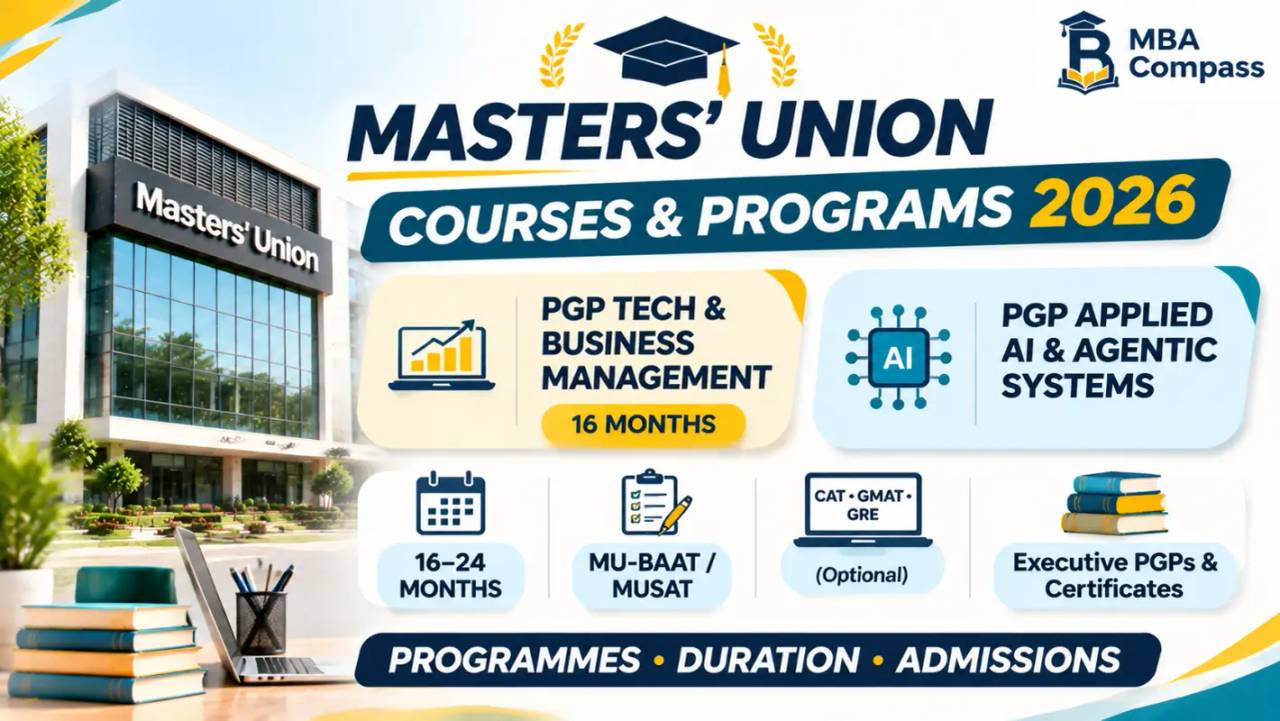
At-a-glance: Masters Union postgraduate programmes 2026
Masters' Union offers multiple postgraduate programmes focused on technology, business and applied AI; applicants usually compare duration, headline fee and accepted tests when choosing. The table below lists the institution's postgraduate options that are explicitly documented in 2026 sources and the admissions tests they accept.
| Program Name | Overview | Duration (months) | Total Fees (INR) | Accepted entrance tests | Eligibility Overview |
|---|---|---|---|---|---|
| PGP Tech & Business Management (PGP-TBM) | Practitioner-led programme blending technology and business skills | 16–24 | ₹32.75 Lakh | MUSAT; optionally CAT/GMAT/GRE | Bachelor's degree (minimum 50%); profile, interview, test (where applicable) |
| PGP Applied AI & Agentic Systems | Applied AI curriculum for graduates and early professionals | 24 | ₹11.35 Lakh | MUSAT; optionally GMAT/GRE/CAT | Bachelor's degree; preference for relevant background; selection via profile and interview |
| PGP Rise / Professional PGPs (certificate-to-PGP pathways) | Shorter professional PGP and certificate tracks in specialised areas | 6–16 | ₹14.5–42.8 Lakh (range reported) | MUSAT; other standardised tests optional | Bachelor's degree; programme-specific criteria and interviews |
The table uses figures and programme names recorded in public 2026 updates for Masters' Union. Use this table to shortlist which programme length, cost and test profile match your background before reading the detailed programme sections.
PGP Tech & Business Management (PGP-TBM) — programme detail
The PGP Tech & Business Management (PGP-TBM) at Masters' Union is a practitioner-led postgraduate programme combining technology fundamentals with core management training delivered through industry projects and mentorship. The programme emphasises product, strategy and data-led roles and runs on an accelerated, cohort-based calendar.
Structure and duration: The flagship PGP-TBM is described as a 16-month programme in Masters' Union public materials. Instruction mixes short practitioner modules, case work, labs and live corporate projects rather than a traditional semester-only model.
Eligibility: Applicants require a recognised bachelor's degree; work experience is not mandatory but applicants with early-career experience are considered favourably. Admissions evaluate academic record, essays, recommendations and MU-BAAT/MUSAT or other accepted test scores where submitted.
Fees and financing: Official listings show PGP programmes at Masters' Union with total fees reported in the range around INR 32.75 lakh for PGP Tech & Business Management (published programme fee in Masters' Union summaries). Masters' Union offers named merit and need-based scholarships; details and slab values vary by award and admission round.
| Specialisation/Focus | Core modules | Duration | Internship/Capstone | Fees |
|---|---|---|---|---|
| Product Management, Strategy, Data & AI | Product labs, Strategy workshops, Data analytics, Technology for business | 16 months | Live industry projects and capstone practicum with corporate partners | INR 32.75 lakh |
Practical experience elements: The PGP-TBM places heavy weight on live projects, internships and mentorship from industry leaders. Cohort activities include business simulations, clinics with partner firms and a final capstone that integrates product, strategy and technical delivery.
Masters' Union published programme descriptions list 16 months and a PGP-TBM fee of INR 32.75 lakh in institutional summaries; applicants should confirm current fees and scholarship availability on the official site.
Also Read: Masters' Union vs Other B-Schools: Fees & Placements 2026
PGP Applied AI & Agentic Systems — programme detail
The PGP Applied AI & Agentic Systems trains graduates to build and deploy production-grade AI products while understanding strategic, ethical and business implications. The course balances technical depth (machine learning, agent architectures, systems engineering) with management modules (product strategy, AI ethics, go-to-market and stakeholder management).
Duration and fees for the PGP Applied AI are listed in Masters' Union course summaries for 2026; the institute publishes PGP programmes under a range of total fee bands for postgraduate courses. Admissions require a bachelors degree and evaluation through Masters' Unions assessment pathway (MU-BAAT/MUSAT) with options to submit standardized scores such as GMAT, GRE or CAT where applicants wish to strengthen their profile. Work experience is not mandatory but relevant early-career experience is considered positively in selection.
Below is a compact table outlining typical curriculum focus areas, drawn from Masters' Union published programme categories for PGP and PGP-Tech offerings in 2026.
| Specialisation/Focus | Technical modules | Business modules | Duration | Fees |
|---|---|---|---|---|
| Applied AI & Agentic Systems | Machine Learning, Deep Learning, Agent Architectures, MLOps, Model Deployment | AI Product Management, Strategy, Ethics & Governance, GTM | 16 months–24 months (Masters' Union PGP range) | INR 32.75 Lakhs – Masters' Union PGP fee band reported for 2026 |
Interpretation: the curriculum integrates hands-on engineering (MLOps, deployment) with product and policy coursework so graduates can lead cross-functional AI initiatives. Candidates without prior coding experience should prepare for an intensive technical module early in the programme.
Masters' Union lists MUSAT/MU-BAAT as its primary assessment for admissions; submission of CAT, GMAT or GRE scores is optional and used to strengthen applications (Masters' Union course data, updated June 2026).
Executive programmes and short certificates
Masters' Union offers a portfolio of executive-degree and short-certificate programmes aimed at mid-career professionals and executives who need focused, practice-oriented upskilling rather than a full-time PGP. These programmes target experienced managers, specialists in technology or product roles, founders and entrepreneurs seeking compressed, industry-led learning.
Below table lists programmes, target audience, typical duration, delivery mode and documented fees where provided by Masters' Union sources.
| Programme Name | Target Audience | Duration | Delivery Mode | Fees (INR) |
|---|---|---|---|---|
| PGP (Professional diploma / Executive PGP) | Graduates and early-career professionals, 0–3 years experience (programme-specific) | 16–24 months | Regular / on-campus (practitioner-led) | ₹11,35,000 – ₹16,85,000 |
| PGP Rise / Certificate range | Mid-career professionals, executives and technology leaders | Short-term / modular (weeks to months) | Blended / cohort-based | ₹14,50,000 – ₹42,80,000 |
| Standalone Certificate Programmes | Working professionals seeking skill upgrades | Short courses (months) | Online / blended | ₹2,30,000 – ₹4,20,000 |
The published ranges above come from Masters' Union course listings and site summaries for 2026. Fees and exact duration vary by intake and specific certificate. Executive PGPs emphasise casework, industry projects and mentorship; short certificates focus on a single skill (e.g., product, design, AI) and are suitable for managers seeking targeted reskilling without leaving work.
Practical note: professionals with 3–8 years' experience commonly choose executive PGPs for role transition (product, technology leadership, entrepreneurship), while certificates are appropriate for 1–5 year professionals who need rapid skill addition. For application details and programme pages, refer to the official Masters' Union site linked in the admissions section of this article.
Admissions: tests accepted, MU-BAAT/MUSAT and application steps
Masters' Union admits postgraduate candidates using a combination of institutional tests, standardised scores when submitted, and a profile-based assessment. The institute runs its own aptitude assessment (MU-BAAT / MUSAT) and considers CAT, GMAT and GRE as optional supporting evidence.
Below table summarises accepted tests, when to submit them, their role in evaluation and minimum-score guidance where available.
| Accepted Tests | When to submit | Role in evaluation | Minimum guidance |
|---|---|---|---|
| MU-BAAT / MUSAT | At application or institute test window | Primary shortlisting tool for verbal, critical thinking and logical reasoning; required for nomination | No published minimum; scores valid only for the application year (MU guidance) |
| CAT / GMAT / GRE | With application (optional) | Considered as supplementary evidence to strengthen profile | No official cutoffs published; high scores recommended to stand out |
Practical interpretation: Candidates should register for and complete the MU-BAAT/MUSAT during the institute's application window because the MU-BAAT is explicitly used for shortlisting; submitting strong CAT/GMAT/GRE scores is optional but can boost a competitive application.
Application components and stepwise selection
- Online application: complete profile, upload resume, transcripts and pay the fee.
- Test submission: take MU-BAAT/MUSAT (mandatory) and optionally upload CAT/GMAT/GRE.
- Essays: submit two essays (or 2-minute video responses) answering specified prompts.
- Recommendations: up to two references from managers, professors, mentors or stakeholders (VCs/customers) are accepted.
- Shortlisting: MU shortlists candidates using test scores and profile metrics.
- Selection events: shortlisted applicants may face business simulations, aptitude assessments and/or personal interviews.
- Offer: successful candidates receive admission offers and confirm by paying the admission fee.
deadline: CAT 2026 registrations and some application windows were reported open with a final application deadline of expected September 2026 for CAT-related timelines; applicants should check Masters' Union portal for programme-specific deadlines.
Also Read: Masters' Union vs Other B-Schools: Fees & Placements 2026
Eligibility & selection: work experience, academic minimums and recommendations
Masters Union postgraduate programmes accept candidates with a bachelor’s degree and evaluate applications holistically; work experience strengthens candidacy for some cohorts but is not universally mandatory. The admission process weighs academic record, test scores (where submitted), MU-BAAT/MUSAT performance, essays and recommendations.
Academic minimums: applicants should hold a recognised undergraduate degree. The published programme summaries for Masters' Union list a general eligibility threshold of a minimum 50% at the bachelor’s level for postgraduate and certificate programmes (CollegeDekho profile, updated 26 June 2026).
Work experience: work experience is recommended for professional PGP and executive cohorts. The Masters' Union guidance indicates that candidates with employment are given precedence and that fresh graduates may apply; several postgraduate and professional diploma listings state suitability for applicants with 0–3 years experience or that experience is beneficial (CollegeDekho profile, updated 26 June 2026).
eligibility: Minimum 50% bachelor’s degree for postgraduate programmes; work experience preferred for some PGP/executive tracks (source updated 26 June 2026).
Recommendations and documents: applications require a current resume and up to two recommendations (from managers, professors, mentors, VCs or customers) plus two essays or video responses. Shortlisted candidates may be invited to interviews, simulations or aptitude assessments as part of final selection (CollegeDekho, 26 June 2026).
Practical pointers for applicants
- Emphasise measurable impact on your resume: metrics, product outcomes or revenue/efficiency gains demonstrate readiness for practitioner-led cohorts.
- Choose recommenders who can speak to leadership, domain expertise or entrepreneurial outcomes rather than generic references.
- When work experience is limited, use project, internship or extracurricular leadership examples to demonstrate maturity and problem-solving.
- Submit voluntary standardised test scores (CAT/GMAT/GRE) or MUSAT if you have strong results—Masters' Union notes strong scores can strengthen an application.
Also read: Masters' Union vs Other B-Schools: Fees & Placements 2026
Fees, scholarships and financing options 2026
Masters Union postgraduate programmes carry high tuition reflecting practitioner-led delivery and corporate partnerships. The most detailed published figures show a PGP Tech & Business Management fee of INR 32.75 Lakhs (total) and a broader PGP/PGDM range reported at INR 33.6–52.5 Lakhs for certain PGP and undergraduate-linked postgraduate tracks (publication updated 26 June 2026).
Below is a concise table drawn from published 2026 programme data and scholarship details.
| Programme | Published Total Fee (INR) | Scholarship Schemes | Typical Financing Options |
|---|---|---|---|
| PGP Tech & Business Management (PGP-TBM) | INR 32.75 Lakhs | Merit & need-based scholarships (Karthik Ramanna Merit, diversity, women’s scholarships, technology leaders), named scholarships with partial/full tuition waivers | Education loans from national banks, EMIs via college payment plans, scholarship + loan mixes |
| PGP / PGP Rise & Certificate verticals | INR 33.6–52.5 Lakhs (reported range) | Programme-specific merit scholarships; women and diversity scholarships; extracurricular excellence awards | Bank loans, staged fee payment schedules, employer sponsorship for executives |
| Short certificate programmes | INR 2.3–4.2 Lakhs | Selective partial waivers; need-based aid | Short-term personal loans, instalment plans |
Practical interpretation: published scholarship schemes include both full and partial tuition waivers awarded by the selection committee; applicants with high MU-BAAT/MUSAT or standardised test scores and strong profiles stand a better chance for merit awards (publication updated 26 June 2026).
Also Read: Masters' Union vs Other B-Schools: Fees & Placements 2026
UPDATE: Fees and scholarship quantum shown are taken from a Masters' Union 2026 profile updated 26 June 2026. Check the official Masters' Union site or admissions portal for any programme-level changes after that date.
Placements & career outcomes (what to expect)
Masters' Union postgraduate placements show strong outcomes for recent cohorts, with programme-level averages and high top offers reflecting the school's industry-connected model.
The table below summarises the latest published placement metrics available for Masters' Union postgraduate cohorts.
| Cohort Year | Average CTC | Median CTC | Highest CTC | Top sectors | Top recruiters |
|---|---|---|---|---|---|
| 2024 | ₹28.52 LPA | ₹27.66 LPA | ₹61.8 LPA | Finance & Fintech; Consumer Tech; Consulting; Product | BCG; McKinsey & Co.; Accenture; Cred; Google; Microsoft; MakeMyTrip |
| 2025 | ₹33.4 LPA | ₹27.8 LPA | ₹1.28 Crore | Finance & Fintech; Consumer Tech; Product Management | BCG; Bain; Accenture; Google; Microsoft; Cred; Zerodha |
Interpretation: Masters' Union reports a materially higher average CTC for the 2025 cohort versus 2024, driven by a small number of very large offers (the 2025 highest CTC was ₹1.28 Crore). Median CTCs are more stable across cohorts, indicating that a concentrated set of top packages lifts the average.
Recruiter mix is concentrated in consulting, finance/fintech and consumer technology, with frequent product and program management roles. Role types commonly reported include product management, consulting assignments, fintech roles and technology-related roles at large platform companies.
Variations by cohort are expected: cohort size, industry hiring cycles, and the number of high-value offers cause year-to-year swings in average figures while medians and sector patterns remain consistent. Prospective applicants should view averages alongside medians and role distributions when assessing outcomes.
Also Read: Masters' Union vs Other B-Schools: Fees & Placements 2026
Campus, delivery mode, international immersion and partnerships
Masters' Union's primary campus is located at DLF Cyberpark, Phase II, Udyog Vihar, Sector 20, Gurugram, Haryana, 122022. The institute delivers postgraduate programmes predominantly through an on-campus, practitioner-led model with additional hybrid elements for executive and certificate offerings.
Below table summarises campus location, delivery modes, international immersion opportunities and named industry partners that shape learning at Masters' Union.
| Campus Location | Delivery Mode | International Immersion | Industry Partners |
|---|---|---|---|
| DLF Cyberpark, Gurugram, Haryana | On-campus primary; hybrid/online for executive certificates | Global study trips and international learning opportunities (programme-specific) | Microsoft, Google, McKinsey, PwC, EY |
The campus address above is the institute's published location. Delivery mode is listed as primarily regular/on-campus for flagship PGP programmes, while executive and short certificate programmes include hybrid or online delivery options. Masters' Union advertises "international learning opportunities" and global exposure as part of its programmes; these are organised on a programme-by-programme basis rather than as an automatic feature of every intake.
- Industry partners named by the institute support curriculum design, live projects and guest faculty; listed partners include Microsoft, Google, McKinsey, PwC and EY.
- International immersion is available for selected cohorts and typically appears in programme brochures as "global study trips" or "international learning opportunities"; specific partner universities or destinations vary by year and programme.
Interpretation: Candidates should expect face-to-face, practitioner-led teaching at the Gurugram campus for PGP programmes, with hybrid delivery for executive certificates and occasional cohort-specific international trips supported by corporate partners. Confirm programme-specific delivery and planned international modules on the programme page or application portal before applying.
How Masters' Union programmes differ: practitioner-led, experiential learning, mentorship
Masters' Union programmes use a practitioner-led curriculum and intensive experiential learning; this approach shapes classroom activities, internships and students' CVs.
The practitioner-led model places industry leaders, entrepreneurs and senior practitioners at the centre of teaching rather than relying exclusively on academics. Masters' Union describes its faculty and mentors as drawn from industry partners including Microsoft, Google, McKinsey and PwC, and lists practitioner involvement across its PGP and certificate offerings (updated Jun 26, 2026).
Experiential learning at Masters' Union emphasises live projects, business simulations and short-term industry residencies. The institution reports strong industry partnerships and internship outcomes; its 2024 placement data cites 148 recruiters for the cohort and lists consulting, product and technology roles among top offers (placement report, 2024).
Mentorship is structured through one-on-one and cohort-level mentoring by practitioners and alumni. Masters' Union highlights mentorship schemes and named scholarships oriented to women, technology leaders and diversity; these underscore a curated mentor network that supports placements and internships (scholarship descriptions, updated Jun 26, 2026).
For students this pedagogical mix means course time focuses on applied problem solving, portfolio development and role-specific projects that can be cited on CVs. Examples include product-management case projects, consulting problem statements and applied AI portfolios for PGP Applied AI students — all supported by industry mentors and live evaluations.
On CVs and interviews, graduates typically highlight:
- signed project descriptions and measurable outcomes from live client work;
- practitioner recommendations and mentor-led references;
- short-term industry residencies and internship titles rather than classroom-only internships.
These elements, combined with placement statistics such as the reported 2024 average PGP TBM CTC of Rs 28.52 LPA and a highest CTC of Rs 61.8 LPA, strengthen employer-facing narratives around job readiness (placement report, 2024).
Important Points
Applicants should check eligibility, tests, fees and deadlines carefully before applying to Masters Union courses in 2026; the institute uses a holistic profile review and its own aptitude test alongside optional standardised scores.
MU-BAAT/MUSAT scores are used for shortlisting and are valid only for the year they are taken.
At-a-glance checklist
- Programme fit: confirm whether you are applying to the PGP Tech & Business Management (PGP-TBM) or PGP Applied AI & Agentic Systems—durations and fees differ across postgraduate tracks.
- Minimum academics: have a bachelor’s degree with at least 50% (where stated) and prepare your transcripts, CV and up to two recommendations.
- Work experience: not mandatory for many programmes; relevant early-career experience can strengthen applications.
- Entrance tests: prepare to submit MU-BAAT/MUSAT; high CAT/GMAT/GRE scores may be submitted optionally to enhance an application.
- Application components: complete essays (or 2-minute videos), resume, recommendations and the admissions assessment/interview if shortlisted.
- Fees & scholarships: postgraduate fees reported in 2026 materials range across advertised PGP totals; review scholarship categories such as merit, gender and diversity scholarships when budgeting.
- Placements: review the institute’s published placement reports for cohort-specific averages and highest offers before deciding; these are cohort-dependent.
- Location & delivery: expect campus-based programmes in Gurugram with practitioner-led, experiential modules and international exposure opportunities.
Also Read: Masters' Union vs Other B-Schools: Fees & Placements 2026
Important Points
- Programmes offered Masters' Union runs multiple postgraduate options in 2026 including the PGP Tech & Business Management (PGP‑TBM) and PGP Applied AI & Agentic Systems, plus executive certificates.
- Duration The flagship PGP‑TBM is reported as a 16‑month practitioner‑led programme; other PGPs run 16–24 months depending on specialisation.
- Fees Postgraduate fees fall in a range reported as INR 32.75–52.5 Lakhs for degree/PGP programmes; certificate courses start much lower (≈INR 2.3 Lakhs).
- Admissions tests Masters' Union accepts its own aptitude test (MU‑BAAT/MUSAT) and optionally CAT, GMAT, GRE scores for PG admissions.
- Work experience Work experience is not mandatory; candidates with 0–5 years are routinely admitted, while experienced applicants may be preferred for some tracks.
- Learning model The programmes emphasise a practitioner‑led, experiential curriculum with internships, industry projects and mentor networks.
Take the next step: Start your MBA journey today by shortlisting programmes that match your profile, analysing fit with the Profile Analyzer, and modelling returns using the MBA ROI Calculator. To create a targeted list of colleges, try the College Shortlister.
Similar Colleges to Check
Compare these colleges alongside Masters Union Courses & Programs before you finalise your shortlist.
| College | What to compare |
|---|---|
| Union Christian College – Management | Fees, cut-offs and placements |
| Union Christian College Department of Management | Fees, cut-offs and placements |
| IIT Bhilai (MBA) | Fees, cut-offs and placements |
| IIT Dharwad (MBA) | Fees, cut-offs and placements |
| IIT Gandhinagar (MBA) | Fees, cut-offs and placements |
| IIT Gandhinagar (MBA) | Fees, cut-offs and placements |
| IIT Indore (MBA) | Fees, cut-offs and placements |
| IIT Indore (MBA) | Fees, cut-offs and placements |
Related Reads
| Page | Type |
|---|---|
| MBA Compass | Free tool |
| College Shortlister | Free tool |
| Profile Analyzer | Free tool |
| Courses | Free tool |
| DSE courses & Programs 2026: MBA/PGDM Specialisations, Duration & | Guide |
| Narayan Business School courses: Specialisations & Eligibility 20 | Guide |
Frequently Asked Questions
What postgraduate programmes does Masters' Union offer in 2026?
Masters' Union offers postgraduate programmes in 2026 including the flagship PGP Tech & Business Management (PGP‑TBM), PGP Applied AI & Agentic Systems, specialist PGPs in product/UI‑UX and other technology‑business blends, executive MBAs and short certificate programmes.
What tests does Masters' Union accept for PGP admissions?
Masters' Union accepts its own aptitude test (MU‑BAAT/MUSAT) as primary assessment and will consider scores from CAT, GMAT, GRE where submitted; MUSAT is the institute's standard entry assessment for many programmes.
How long are Masters' Union PGP programmes?
Programme lengths vary: the flagship PGP‑TBM is listed as a 16‑month programme, while other postgraduate offerings run between 16 and 24 months depending on the specialisation.
What is the fee range for Masters' Union PGP programmes in 2026?
The publicly reported fee range for Masters' Union postgraduate and select programmes in 2026 is between INR 32.75 Lakhs and INR 52.5 Lakhs; certificate programmes are substantially lower (from about INR 2.3 Lakhs).
Is work experience required to apply to Masters' Union PGP?
Work experience is not a strict requirement for Masters' Union PGP admissions; fresh graduates may apply, though the admissions process gives preference in some cases to candidates with relevant professional experience.
What scholarships are available for Masters' Union students?
Masters' Union publishes several named scholarships including merit, women‑focused and diversity schemes (for example Karthik Ramanna merit, Malavika R Harita, Rajni Thethi and technology leadership scholarships) offering partial to full tuition waivers.
How do I apply and what application materials are required?
Applicants complete an online application, submit resume, up to two recommendations, essays (or video responses), MU‑BAAT/MUSAT or other test scores, and may be invited for interviews, simulations or aptitude assessments as part of final selection.
Conclusion
Masters Union courses present a set of postgraduate options focused on technology, product and business management taught through a practitioner‑led and experiential model. Admissions rely on MU‑BAAT/MUSAT and optional standardised scores; durations typically run from 16 to 24 months and fees are positioned at the higher end of private PGP offerings. Candidates should weigh the intensive industry exposure, internships and mentorship networks against the financial investment when choosing among Masters Union courses.
About MBA Compass
MBA Compass is an MBA discovery and decision platform produced by B School Buzz that helps Indian students and working professionals make informed postgraduate management choices. The site offers tools to shortlist colleges, analyse candidate profiles, compare programmes and simulate admission outcomes. It also supplies detailed fee and ROI analysis so applicants can assess tuition, expected packages and long‑term financial impact before committing to a programme.
For users preparing applications, MBA Compass provides practice materials and mock selection exercises that reflect the practitioner‑led formats used at several modern business schools.
Use the platform to narrow options with the College Shortlister, review how your profile compares to typical admits via the Profile Analyzer, and model lifetime returns with the MBA ROI Calculator.